

Tuberculosis in Children: Symptoms, Diagnosis, Treatment and Prevention
Tuberculosis (TB) in children is an important infectious disease, particularly in countries such as India where tuberculosis remains a significant public health concern. TB is caused by the bacterium Mycobacterium tuberculosis and most commonly affects the lungs, but it can affect other organs as well.
Children can develop tuberculosis after exposure to an infectious person with pulmonary TB. Because TB in children may present with relatively subtle or persistent symptoms, early evaluation is important—particularly when there is a known history of close contact with someone who has tuberculosis.
Tuberculosis is preventable and curable when appropriately diagnosed and treated.
What Is Tuberculosis in Children?
Tuberculosis is an infection caused by Mycobacterium tuberculosis. The bacteria usually enter the body through inhaled air and most commonly affect the lungs.
In children, however, TB can involve organs outside the lungs. This is known as extrapulmonary tuberculosis. Depending on the site of infection, TB may affect the lymph nodes, brain, bones, abdomen or other organs.
Young children are particularly important to assess after exposure to TB because they have a higher risk of developing TB disease after infection.
How Does TB Spread?
Tuberculosis spreads through the air when a person with infectious pulmonary or laryngeal TB releases bacteria while coughing, sneezing, speaking or singing.
The risk of transmission is higher with prolonged, close or repeated exposure, particularly in enclosed or poorly ventilated spaces.
A child who has been in close contact with someone diagnosed with infectious TB should be evaluated even if the child currently appears well. Screening and, when appropriate, tuberculosis preventive treatment can help reduce the risk of developing TB disease.
What Are the Symptoms of Tuberculosis in Children?
TB symptoms in children can be mild and develop gradually. Some children may have symptoms for several weeks before the diagnosis is considered.
Common symptoms of childhood tuberculosis include:
According to India’s pediatric TB guidance, persistent fever or cough for more than two weeks, weight loss or failure to gain weight—particularly in a child with a history of TB exposure—should prompt evaluation for tuberculosis.
Symptoms can vary depending on which part of the body is affected.
What Parts of the Body Can TB Affect?
Although the lungs are the most common site, tuberculosis can affect several organs.
Pulmonary TB – TB of the lungs and mediastinal lymph nodes
Extrapulmonary TB
TB can also affect:
- Lymph nodes
- Brain and meninges, causing TB meningitis
- Bones and joints
- Abdomen and intestines
- Kidneys and urinary tract
- Other organs in more extensive or disseminated disease
TB involving multiple organs is called disseminated tuberculosis.
Because symptoms of extrapulmonary TB can be different from those of lung TB, diagnosis may sometimes be challenging and requires an individualized approach.
When Should a Child Be Evaluated for Tuberculosis?
A child should be evaluated for TB when there are symptoms such as persistent cough or fever, unexplained weight loss or poor weight gain, particularly when these occur together.
Evaluation is especially important if the child has had close contact with a person who has active tuberculosis.
A history of exposure can be important even when the child has few or no symptoms. Children who are household contacts of a person with TB may require screening for TB infection and TB disease and, depending on the findings, preventive treatment.
How Is Tuberculosis Diagnosed in Children?
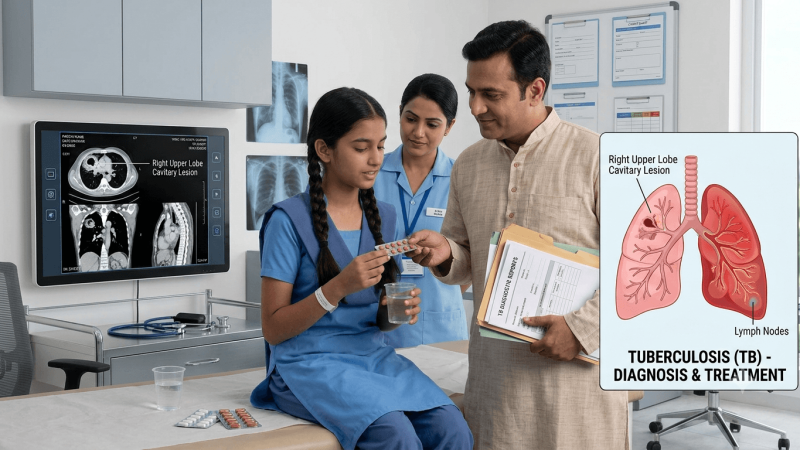
Diagnosing TB in children can be more challenging than in adults because children, especially younger children, may not be able to produce sputum and often have a lower amount of bacteria in respiratory samples.
Diagnosis is based on a combination of:
The National TB Elimination Program (NTEP) guideline recommends rapid diagnostic tests, including molecular tests, as initial diagnostic tools for people with signs and symptoms of TB, with specific approaches for children and for detecting drug resistance.
Tests That May Be Used
Depending on the child’s age and clinical presentation, the doctor may recommend:
Chest X-ray:
A chest X-ray can provide important information when pulmonary TB is suspected. However, an X-ray alone cannot always confirm or exclude tuberculosis.
Molecular testing:
Rapid molecular tests can detect M. tuberculosis and, depending on the test, provide information about resistance to rifampicin. These tests are increasingly important in the diagnosis of TB and drug-resistant TB. This test can be performed on sputum, lymph node aspirate, gastric aspirate, bronchoalveolar lavage, CSF (Brain fluid) or even biopsy samples.
Test to prove Latent TB Infection
The following tests only confrim exposure to tuberculosis but do not confirm active TB disease. Positive result in any of these tests warrants further evaluation to confirm diagnosis in relevant clinical setting.
Tuberculin skin test (Mantoux test):
The Mantoux test can help identify TB infection. It needs to be interpreted in the context of the child’s clinical history, exposure and other investigations.
IGRA:
An interferon-gamma release assay (IGRA) is another test that can help detect TB infection in appropriate situations.
How Is a TB Sample Collected From a Child?
Obtaining a respiratory sample can be difficult in young children because they often cannot produce sputum on request.
Depending on the child’s age and clinical situation, samples may be obtained using techniques such as:
Induced Sputum
A saline solution may be used to help induce coughing so that respiratory secretions can be collected for testing.
Gastric Aspirate
In selected young children who cannot produce sputum, respiratory secretions that have been swallowed overnight may be collected from the stomach using a tube and sent for appropriate testing.
Flexible Bronchoscopy
Bronchoalveolar lavage sample obtained by flexible bronchoscopy is the most high-yielding good quality sample for microbiological diagnosis of tuberculosis. To know more about flexible bronchoscopy, click here
The choice of sampling technique depends on the child’s age, symptoms, clinical condition and the tests required.
What Is the Treatment for Tuberculosis in Children?
Tuberculosis is treatable and curable. Treatment involves a combination of anti-tuberculosis medicines prescribed according to the type of TB, the child’s age and weight, the site and severity of disease, and whether drug resistance is suspected or confirmed.
Common first-line medicines used in appropriate treatment regimens include:
- Isoniazid (H)
- Rifampicin (R)
- Pyrazinamide (Z)
- Ethambutol (E)
However, not every child with TB receives exactly the same duration of treatment. Treatment duration and drug combinations depend on whether the child has non-severe or severe disease, pulmonary or extrapulmonary TB, TB meningitis, bone or joint disease, drug-resistant TB and other clinical factors.
TB medicines are associated with adverse effects that need monitoring at frequent intervals.
Therefore, treatment should always be prescribed and monitored by a doctor familiar with pediatric tuberculosis.
Why Is Completing TB Treatment Important?
Anti-TB medicines need to be taken exactly as prescribed. Stopping treatment early, missing doses or taking medicines incorrectly can lead to treatment failure and contribute to drug resistance.
Regular follow-up helps monitor:
What Is TB Preventive Treatment?
Not every child exposed to TB develops active TB disease.
After a child has been exposed to someone with TB, doctors may evaluate the child for TB infection and TB disease. If active TB disease has been ruled out and the child is considered at increased risk, TB preventive treatment may be recommended.
NTEP recommends TB preventive treatment for people at increased risk of progressing from TB infection to disease, including appropriate household contacts of people with TB.
What Is Multidrug-Resistant TB (MDR-TB)?
Multidrug-resistant tuberculosis (MDR-TB) is TB caused by bacteria that are resistant to at least isoniazid and rifampicin, two of the most important first-line anti-TB medicines.
Drug-resistant TB requires specialized testing and a different treatment approach. Modern molecular tests can help identify tuberculosis and detect important forms of drug resistance more rapidly, allowing treatment to be selected more appropriately.
Children who have been exposed to someone with drug-resistant TB require particularly careful evaluation and specialist management.
Why Early Diagnosis of TB Matters in Children
Tuberculosis can sometimes progress more rapidly in young children, and some forms—particularly TB meningitis and disseminated TB—can be serious.
Early recognition of persistent symptoms and appropriate evaluation after significant TB exposure can help identify children who need treatment or preventive therapy.
If your child has persistent cough, prolonged fever, poor appetite, unexplained weight loss or poor weight gain, or has been in close contact with someone with tuberculosis, consult a pediatrician or pediatric pulmonologist for an appropriate evaluation.
Frequently Asked Questions About Tuberculosis in Children
Early symptoms may include persistent cough, fever, poor appetite, weight loss or failure to gain weight, tiredness and reduced activity. Some children may have few symptoms, particularly early in the disease.
Yes. TB does not always affect the lungs. Children can develop extrapulmonary TB involving the lymph nodes, brain, bones, abdomen and other organs. Therefore, the absence of cough does not completely rule out tuberculosis.
A persistent cough lasting two weeks or longer, particularly when associated with fever, weight loss, poor weight gain or TB exposure, should be medically evaluated. However, the duration of symptoms is only one part of the assessment.
No. Exposure does not automatically mean that a child will develop TB disease. Children who have been exposed should be assessed for TB infection and TB disease, and preventive treatment may be recommended for children at increased risk after active TB has been ruled out.
Tuberculosis is generally curable when it is diagnosed appropriately and treated with the correct medicines for the recommended duration. Completing treatment and attending follow-up appointments are essential.
TB is primarily spread through the air from a person with infectious pulmonary or laryngeal TB. It is not typically transmitted simply by sharing food or utensils.
Yes. Tuberculosis can affect the brain and meninges, causing TB meningitis. This is a serious form of TB that requires prompt diagnosis and specialist treatment.
A pediatric pulmonologist can help evaluate a child with persistent respiratory symptoms, prolonged fever, unexplained weight loss or poor weight gain, recurrent respiratory problems, suspected pulmonary TB, a significant TB exposure, or suspected drug-resistant TB.
Pediatric Tuberculosis Care
Tuberculosis in children requires a careful, child-specific approach to diagnosis, treatment and prevention. Because symptoms can be subtle and children may be unable to provide adequate respiratory samples, evaluation should consider the child’s age, symptoms, growth pattern, exposure history and clinical findings.
If you are concerned that your child may have tuberculosis or your child has been exposed to someone with TB, seek medical evaluation rather than waiting for symptoms to become severe.
Dr Ritika Goyal, Pediatric Pulmonologist and Allergy Specialist in Delhi, provides evaluation and management of childhood respiratory diseases, including suspected tuberculosis, recurrent respiratory symptoms and other pediatric lung conditions.
Disclaimer: This page is intended for general educational information and does not replace a medical consultation. TB diagnosis, preventive treatment and anti-tuberculosis medicines should be prescribed and monitored by a qualified healthcare professional based on the individual child’s clinical condition.