

Stridor in Babies and Children: A Sign of Upper Airway Narrowing
Stridor is a loud, high-pitched breathing sound that can occur when a child has narrowing or partial blockage of the upper airway. It is particularly important in babies and young children because their airways are small, so even a relatively minor narrowing can cause significant breathing difficulty.
If your baby or child develops stridor, noisy breathing, or signs of breathing difficulty, prompt medical assessment is important. Stridor is a symptom, not a diagnosis, and identifying its underlying cause is essential for appropriate treatment.
Understanding the Child’s Airway
When we breathe, air enters through the nose and travels through the nasal passages into the pharynx (throat). The pharynx is shared by both the respiratory and digestive systems.
From the pharynx, air passes through the larynx (voice box) and then into the trachea (windpipe). A leaf-shaped structure called the epiglottis helps protect the airway during swallowing by closing over the entrance to the larynx and preventing food or liquid from entering the lungs.
The trachea then divides into the right and left main bronchi at a point called the carina. The bronchi continue deeper into the lungs and divide into progressively smaller airways.
Any partial or complete obstruction of this airway pathway can cause noisy breathing, respiratory distress, and difficulty breathing.
What Is Stridor?
Stridor is a loud, harsh, high-pitched breathing sound, usually more noticeable when a child breathes in. It occurs because air is passing through a narrowed or partially blocked upper airway.
In babies and young children, stridor may become more prominent when the child is crying, agitated, or upset. A mild sound may be heard when the baby is calm but become much louder with crying.
Stridor may also be associated with signs of increased breathing effort, such as:
Is Stridor an Emergency?
Stridor should never be ignored in a baby or child. The urgency depends on its severity and underlying cause.
Stridor that occurs at rest, is accompanied by significant breathing difficulty, bluish discoloration, drooling, difficulty swallowing, reduced alertness, or rapidly worsening symptoms requires urgent medical evaluation.
Common Causes of Stridor in Children
Stridor can have many causes. Some are temporary and related to infections, while others are related to the structure or function of the airway.
Infectious Causes
Common infections that can cause stridor include:
- Croup (laryngotracheobronchitis) – a common viral infection causing swelling around the voice box and upper airway
- Epiglottitis – a potentially serious infection causing swelling around the epiglottis
- Bacterial tracheitis – a bacterial infection involving the trachea
Because some infectious causes can progress rapidly, children with significant stridor need timely medical assessment.
Congenital Causes of Stridor
Some children are born with an airway condition that causes noisy breathing. These may include:
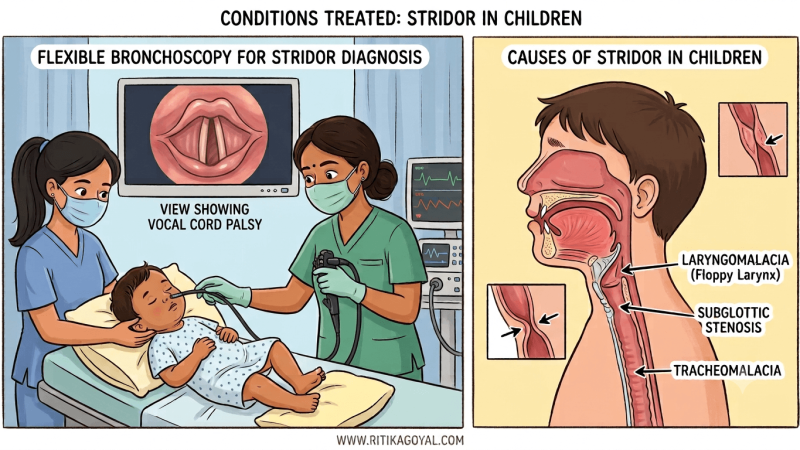
Laryngomalacia
Laryngomalacia is one of the most common causes of stridor in infants. The tissues around the larynx are softer than usual and can collapse inward during breathing, producing characteristic noisy breathing.
Many cases improve as the child grows, but babies with severe symptoms, feeding difficulties, poor weight gain, or breathing problems require specialist evaluation.
Other Congenital Airway Conditions
Other conditions present from birth may include:
- Vocal cord paralysis
- Laryngeal web
- Subglottic stenosis
- Congenital tracheal narrowing due to weakness (tracheomalacia) or stenosis
- Other anatomical abnormalities of the larynx or trachea
- Weakness of the airway associated with neurological conditions
Acquired Causes of Stridor
Children can also develop stridor after birth due to conditions affecting the airway, including:
- Viral or bacterial upper respiratory tract infections – Croup
- Foreign body aspiration
- Retropharyngeal or peritonsillar abscess
- Anaphylaxis or severe allergic reaction
- Acquired laryngeal webs
- Acquired subglottic stenosis
- Vocal cord paralysis or palsy – acquired
- Masses or other lesions involving the trachea
A sudden onset of stridor, particularly while eating or playing, raises concern for a possible inhaled foreign body and requires urgent assessment.
What Should Parents Do If Their Baby Has Stridor?
If your baby has noisy breathing or stridor, do not try to diagnose the cause at home.
A baby who has stridor from birth or develops stridor during the first few days of life should be evaluated by a pediatric pulmonologist. Some babies may require detailed assessment of the upper and lower airway.
If stridor develops suddenly at home or is associated with breathing difficulty, the child should be taken to a hospital for prompt evaluation.
While waiting for medical care:
- Keep the child as calm as possible, since crying can worsen noisy breathing.
- Do not force food or liquids if the child is having difficulty breathing or swallowing.
- Seek emergency medical care if breathing becomes difficult or symptoms rapidly worsen.
How Is Stridor Diagnosed?
The evaluation of stridor begins with a careful clinical examination and assessment of the child’s breathing. After assessing the child thoroughly, the doctor may decide to investigate by doing a flexible bronchoscopy.
Flexible Bronchoscopy
Flexible bronchoscopy is the gold standard test to find out the cause of stridor. It helps the doctor assess the airway in real-time. The dynamic changes in the airway that are associated with crying, feeding or sleeping can also be assessed in detail by flexible bronchosocpy. It can provide a detailed evaluation of the airway from the nose and upper airway through the trachea and into the bronchi.
To know more about Pediatric and Neonatal flexible bronchoscopy, click here
When Should Parents Seek Urgent Medical Attention?
Seek urgent medical care if your child has stridor along with:
Key Takeaway for Parents
Stridor is not a disease itself—it is a sign that the airway may be narrowed or obstructed. In babies and children, identifying the cause early is important because the pediatric airway is small and can become significantly compromised with even modest swelling or narrowing.
Causes range from common conditions such as croup and laryngomalacia to more serious problems such as foreign body aspiration, airway abnormalities, infections, or airway obstruction.
If your child has persistent, recurrent, or unexplained noisy breathing, evaluation by a pediatric pulmonologist can help determine the cause and guide appropriate treatment.
Frequently Asked Questions About Stridor in Children
Stridor is typically a loud, harsh, high-pitched breathing sound. It is often more prominent while breathing in, although the sound can vary depending on the location and severity of airway narrowing.
Noisy breathing can occur in otherwise well babies, particularly with conditions such as mild laryngomalacia. However, persistent or significant stridor should be evaluated to determine the underlying cause.
No. Laryngomalacia is a condition that can cause stridor. Stridor is the breathing sound produced by narrowing or altered airflow through the airway.
Yes. Viral infections such as croup can cause swelling of the upper airway and lead to stridor. However, not every case of stridor is caused by an infection.
A child should be assessed by a pediatric pulmonologist when stridor is persistent, recurrent, unexplained, present from birth, associated with feeding or growth problems, or accompanied by breathing difficulty. Urgent symptoms require immediate hospital evaluation rather than waiting for a routine appointment.
Some causes, such as mild laryngomalacia or viral croup, may improve with time or appropriate treatment. However, parents should not assume that stridor will resolve without evaluation, particularly when it is persistent or associated with breathing difficulty.