

Why Is Good Quality Sleep Important in Children?
Sleep plays a crucial role in the development of young minds. In addition to having a direct effect on happiness, research shows that sleep impacts alertness and attention, cognitive performance and mood.
Sleep also has important effects on growth, especially in young infants and toddlers.
According to the American Academy of Pediatrics, 25% of children under the age of 5 years do not get adequate, good-quality sleep.
This is concerning because insufficient or poor-quality sleep in children can contribute to several health and developmental problems, including:
- Poor growth
- Poor academic performance
- Mood swings and hyperactivity
- Anxiety and depression
- Poor immune system development
- Allergic rhinitis and its complications
- Poor control of allergic disorders
- Increased risk of cardiovascular diseases later in life
The Brain Follows a Natural Sleep–Wake Rhythm
Our body has an internal biological clock, located in a part of the brain called the hypothalamus. This clock helps regulate when we feel awake and when we feel sleepy.
Two important processes control sleep:
- Circadian Rhythm: This is the body’s internal 24-hour clock. Light exposure during the day helps maintain this rhythm. As evening approaches, the brain increases the release of melatonin, a hormone that signals that it is time to prepare for sleep.
- Sleep Pressure: The longer a child stays awake, the greater the body’s drive to sleep. A chemical called adenosine gradually builds up in the brain during wakefulness and contributes to this feeling of sleepiness.
Together, these processes help children fall asleep and maintain a regular sleep–wake schedule.
Bright light and screen exposure late in the evening can interfere with the body’s natural preparation for sleep, making it harder for some children to fall asleep at the appropriate time.
Stages of Sleep
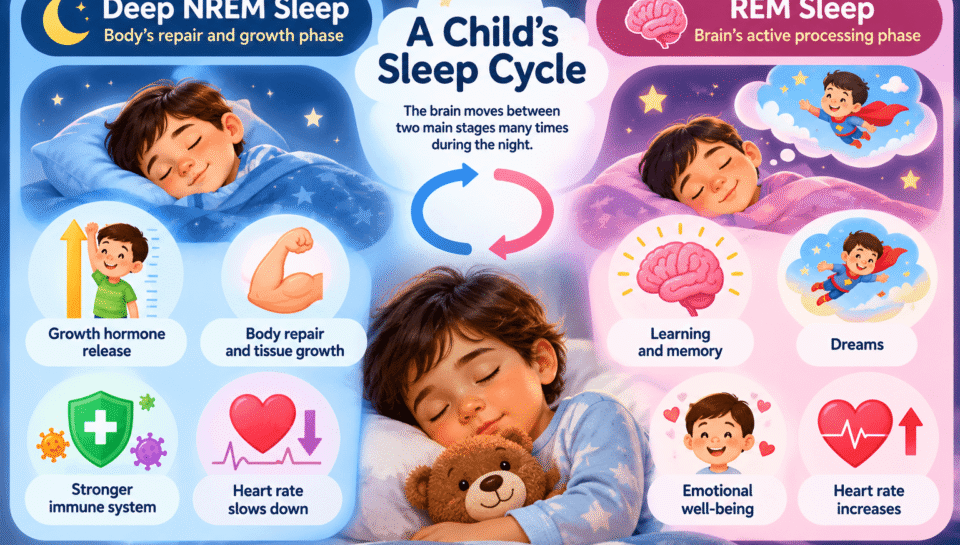
Sleep is not a uniform state. Throughout the night, the brain cycles through different stages of non-rapid eye movement (NREM) sleep and rapid eye movement (REM) sleep.
- Deep NREM Sleep: The body’s repair and recovery phase.
- REM Sleep: The brain’s active processing phase.
NREM and REM sleep perform complementary functions. Children need sufficient total sleep and a healthy pattern of sleep stages to support both physical development and brain maturation.
The proportion of time spent in different sleep stages changes as children grow. Infants, for example, have different sleep patterns from school-aged children and adolescents.
What Happens in a Child’s Body During Sleep?
1. Growth Happens During Sleep
Sleep plays an important role in physical growth and development.
- Growth hormone is released in pulses and supports bone and muscle growth.
- The body continues to build and repair tissues.
- Protein synthesis and other metabolic processes support recovery.
- Energy stores are regulated to help meet the body’s needs.
- Hormones involved in appetite and metabolism are influenced by sleep duration and quality.
2. Sleep Strengthens Brain Development
During sleep, neural connections are modified and important memories are consolidated. This helps children retain newly learned skills, strengthen knowledge and prepare the brain for further learning.
Adequate sleep also supports attention, problem-solving, emotional regulation and behaviour.
Children who do not get enough quality sleep may experience difficulty concentrating, irritability, mood changes and reduced school performance.
Interestingly, some sleep-deprived children may appear unusually restless or hyperactive rather than obviously sleepy.
3. Sleep Strengthens the Immune System
The immune system protects children against viruses, bacteria and other harmful organisms. Sleep and immunity influence each other in both directions.
During sleep, the body regulates immune signalling molecules and supports processes involved in immune memory and responses to infection.
Good sleep is therefore an important part of a child’s overall health, alongside balanced nutrition, vaccination, physical activity and appropriate medical care.
4. Sleep Helps Regulate Mood, Appetite and Behaviour
Sleep affects more than physical growth. It also influences the hormones and brain networks that regulate hunger, fullness, stress responses and emotional well-being.
Insufficient sleep can affect appetite regulation, glucose metabolism and the body’s response to stress.
Over time, habitual inadequate sleep is associated with an increased risk of unhealthy weight gain and other metabolic problems.
Children who sleep well are generally better equipped to manage emotions, cope with everyday challenges and participate actively in learning and play.
What Is the Adequate Duration of Sleep in a Child?
The recommended amount of sleep varies depending on a child’s age.
| Age Category | Age Group | Recommended Sleep Duration |
|---|---|---|
| Newborn | 0–3 months | 14–17 hours |
| Infant | 4–12 months | 12–16 hours (including naps) |
| Toddler | 1–2 years | 11–14 hours (including naps) |
| Preschool | 3–5 years | 10–13 hours (including naps) |
| School Age | 6–12 years | 9–12 hours |
| Adolescent | 13–18 years | 8–10 hours |
Reference: Insufficient Sleep in Adolescents and Young Adults: An Update on Causes and Consequences. Judith Owens, Adolescent Sleep Working Group, Committee on Adolescence. Pediatrics, September 2014; 134(3): e921–e932. DOI: 10.1542/peds.2014-1696.
What Is Sleep Hygiene?
Certain practices followed before bedtime and during the day can help improve sleep in children of all age groups. These are collectively called sleep hygiene methods.
Bedtime Sleep Hygiene Tips for Children
At night, a consistent bedtime routine is helpful for making sure your child gets enough sleep.
Try to do the same activities every day in the same order so your child forms a habit.
A typical bedtime routine would include:
- Turning off computers, TV screens, video games and other bright lights.
- Putting on night clothes and brushing teeth.
- Reading a light book, singing a lullaby or taking a bath.
- Putting the baby to sleep in their own bed when they are drowsy or partially asleep.
Daytime Sleep Hygiene Tips for Children
During the day, the following sleep hygiene rules should be followed:
- Arrange a balanced schedule with interspersed periods of rest and play.
- Maintain a regular bedtime.
- Make the bedroom a no-screen zone, even during the day.
- Avoid caffeine, large meals and sugary treats before bedtime, opting for a healthy bedtime snack if necessary.
What Are the Various Sleep-Related Problems in Children?
Issues that might seem minor to adults, such as a new sibling, teething, an illness, a different place, a new caregiver or a change in schedule, can significantly affect a child’s sleep.
Minor health complaints such as allergies, colds and ear infections may also disturb sleep.
Sleep disorders are closely connected with mental and physical health issues, with one potentially worsening the other in a cycle that can be difficult to break.
Some of the most common sleep-related disorders in children include:
- Obstructive sleep apnea
- Night terrors and nightmares
- Sleep talking and sleepwalking
- Snoring
- Restless leg syndrome
What Can Be Done About Sleep Problems in Children?
If you think your child may be suffering from one of these sleep disorders, consider the following steps:
- Keep a sleep diary: Track your child’s symptoms and sleeping patterns.
- Establish good sleep hygiene habits: Maintain consistent bedtime routines and healthy sleep practices.
Consult a Pediatric Pulmonologist for guidance, evaluation and appropriate treatment if your child is experiencing sleep-related breathing problems or other persistent sleep disturbances.